Media & Interviews · 10 August 2026 · 8 min read
As Seen on Garuda TV: Why Nesara Bay City Is South Lombok's Most Watched Development
South Lombok has moved from a quiet corner of Indonesia's tourism map to one of the country's most closely watched development regions. The Garuda TV segment above places that shift in a national context: new infrastructure, a maturing visitor economy and a property market that is only beginning to formalise.
Why South Lombok is receiving increasing attention
For two decades, Indonesian coastal investment was concentrated in Bali. South Lombok — Kuta, Mandalika, Selong Belanak, Ekas — remained comparatively undeveloped despite a coastline many consider the equal of anything in the archipelago. Attention has shifted for practical reasons: land availability, a designated national tourism zone, and a road and utilities program delivered ahead of, rather than behind, demand.
Infrastructure is arriving first
The Mandalika Special Economic Zone brought an international-standard circuit, a widened bypass linking the airport to the south coast, upgraded water and power provision, and a steady increase in scheduled international arrivals at Lombok International Airport. In Bali, infrastructure largely followed tourism and has spent years catching up. In South Lombok the sequence is reversed, which changes how the region can absorb growth.
Tourism growth and what it means locally
Visitor numbers to Lombok have risen consistently as flight connectivity improves and Bali's southern corridor becomes more congested. The profile is broadening beyond surf and backpacker travel toward longer-stay visitors, families and remote workers — the segment that supports year-round accommodation demand rather than seasonal peaks.
What is changing in the local property market
Historically, South Lombok land transacted informally, with unclear title, no zoning certainty and little professional management. That is changing. Masterplanned precincts, properly certified leasehold and Hak Pakai structures, and internationally managed rental operations are now present in the market. The practical effect for buyers is a widening gap between certified, serviced projects and unstructured land deals that continue to carry substantial risk.
Why projects like Nesara Bay City attract coverage
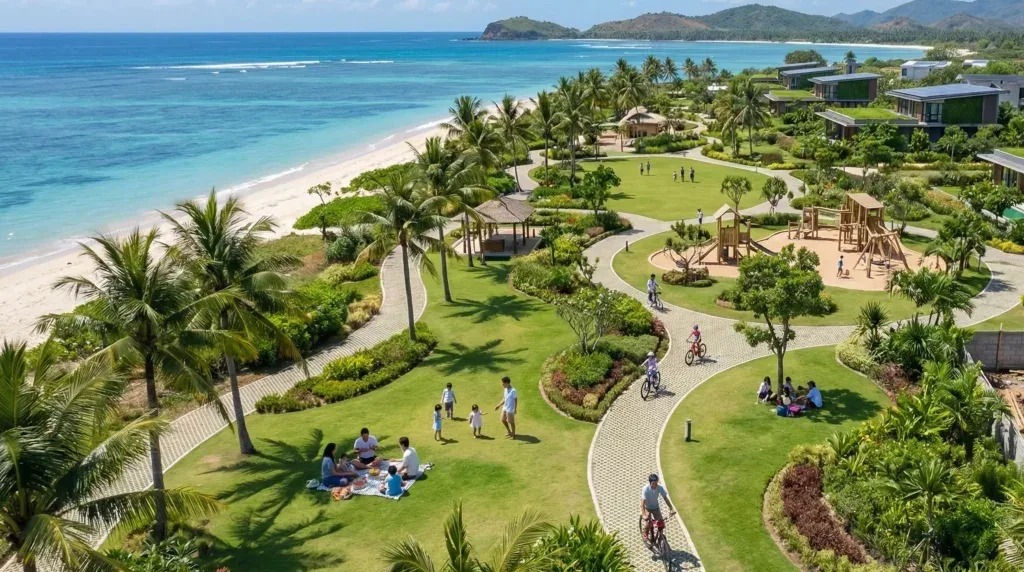
Nesara Bay City appears in the Garuda TV report not as an advertisement but as a case study: a large-scale waterfront precinct planned as a complete city — residential, hospitality, retail and public realm — rather than a series of unrelated villa plots. Media interest tends to follow projects at that scale because they signal where roads, utilities and employment are likely to concentrate next.
The broader economic context
Indonesia is among the fastest-growing large economies, with a young population and rapid urbanisation. Regional tourism precincts such as Mandalika are part of a deliberate national strategy to spread visitor economies beyond Bali and Java. Development in South Lombok should be read within that policy framework rather than as an isolated property cycle.
What international buyers should understand
- Title structure matters more than price. Foreign ownership is held through leasehold, Hak Pakai or a PT PMA company. Each carries different rights, durations and tax treatment.
- Verify zoning and certification before considering any land parcel; much of the region's informal market cannot be certified for accommodation use.
- Infrastructure timelines are public record. Assess a location against delivered, funded works rather than announced intentions.
- Operational capability determines yield. Occupancy in an emerging market depends on professional management, distribution and maintenance far more than on nightly rate.
- Time horizons are longer than in mature markets. South Lombok is an early-stage region, and returns should be modelled accordingly.
This article is general information only and is not legal, financial or taxation advice.